
Murrybowl journal
Brachycephalic Dog Bowls: What to Look For
A practical buying guide for Frenchies, Pugs, Bulldogs, and other flat-faced Paw Pals.

A brachycephalic dog bowl is simply a bowl chosen with a flat-faced pet’s everyday meal in mind. French Bulldogs, Pugs, English Bulldogs, Boston Terriers, Shih Tzus, and other short-muzzled Paw Pals do not all eat the same way, so there is no one “correct” shape or height. The useful place to start is the meal you already serve.
Look for a feeding surface your pet can approach without working around a high rim or tight corner, a base that stays settled where you feed, and a setup you can keep clean. Those are practical jobs a bowl can support. A bowl is not a medical treatment, and health, breathing, swallowing, or ongoing feeding concerns belong with your veterinarian.
What “brachycephalic” means at mealtime
Brachycephalic means short-headed. In daily life, pet parents often use it to describe the flat-faced look of breeds such as French Bulldogs, Pugs, English Bulldogs, Boston Terriers, and Shih Tzus. That shared look is a useful reason to pay attention to bowl shape, but it is not a shortcut to a universal feeding prescription.
One Frenchie may take neat, measured bites from an ordinary dish. Another may push kibble to the edge, chase a lightweight bowl across tile, or find deep curves annoying. A Pug, Bulldog, or Boston Terrier can be equally individual. Age, body size, food texture, portion size, flooring, and the pet’s own habits all change what is useful.
That is why the most reliable advice is observation rather than a dramatic claim about what every flat-faced dog “needs.” Keep the meal familiar, then look at access, stability, cleanup, and what your pet leaves behind. Those details give you a much better way to compare bowls.
Start with one ordinary meal
You do not need a formal feeding test. Put down the normal measured meal in the usual location and take a quiet minute to notice the routine. An enthusiastic eater is not automatically uncomfortable, and a little food around the bowl is not automatically a problem. Look for a repeated pattern that makes eating or cleanup harder than it needs to be.
- Watch the approach. Your pet should be able to come toward the food without repeatedly backing away, circling the bowl, or forcing their face into a cramped interior.
- Notice where food settles. Kibble that consistently ends up against a distant rim, or wet food left in a tight ring, can suggest that the inside shape is not helping.
- Check the bowl’s footing. If the dish skates, spins, or tips when your pet leans in, the routine becomes more work for everyone.
- Look at the end of the meal. A useful bowl leaves the food reachable and the feeding area reasonably simple to reset for next time.
If you are changing a bowl, change one thing at a time. Keep the food, portion, and feeding spot familiar for the first few meals. That makes it easier to see whether the new surface is genuinely useful, rather than mixing it with a new diet or routine.
Look for an open, reachable feeding surface
The inside of a bowl matters more than its silhouette on the shelf. Deep, narrow interiors can send food toward a tall rim or a distant curve. An open surface gives food a clearer place to land and gives a short muzzle more room to approach it. That is a practical distinction, not a promise that one angle will solve every feeding concern.
Match the surface to the food you actually serve. With dry food, watch whether pieces roll into a corner beyond your pet’s easy reach. With wet food, look for a surface that can be licked clean without creating a stubborn ring at the edge. For a mixed meal, check whether the parts stay in a useful area instead of separating across a big, hard-to-manage dish.
This is also where generic breed labels can be misleading. A bowl advertised for a “bulldog” may still have a narrow inside, a high rim, or a capacity that does not match your Paw Pal’s normal meal. The right fit is visible in the feeding routine, not just in the product title.
Keep height claims in perspective
Many bowl listings make confident promises about elevation, posture, digestion, or breathing. Those claims sound tidy, but individual fit is more nuanced. A raised bowl is not automatically better for every brachycephalic pet, and a floor-level bowl is not automatically a poor choice. A bowl should not be sold as a substitute for veterinary advice or care.
For a healthy pet with no particular concern, start with the basic question: can they get to the food comfortably and finish a normal meal without the bowl becoming an obstacle? If you are thinking about a raised setup because of coughing, repeated regurgitation, trouble swallowing, breathing concerns, or a diagnosed condition, ask your veterinarian before treating a bowl height as the answer.
That is a more helpful standard than a one-size-fits-all rule. It keeps the decision focused on the pet in front of you and helps separate practical product features from medical claims.
Choose stability before extra features
A bowl that moves around can turn an ordinary meal into a small chase. Look for a broad footprint, enough weight to settle on your floor, and a shape that is balanced when food is inside it. Rubber feet can be useful, but they are a detail, not a replacement for a well-considered base.
Try a simple home check before buying anything new: place the current empty bowl where your pet usually eats and nudge it gently with one hand. If it slides across tile, wood, or laminate before the meal starts, a more substantial option may make the setup easier to manage.
Murrybowl stays at floor level and uses a weighted 4.12-pound base with a flat exterior back. Those design choices are intended to help it settle against a wall or cabinet and reduce the small slides and spins that make a feeding area messy. They are straightforward daily benefits, not a health claim.
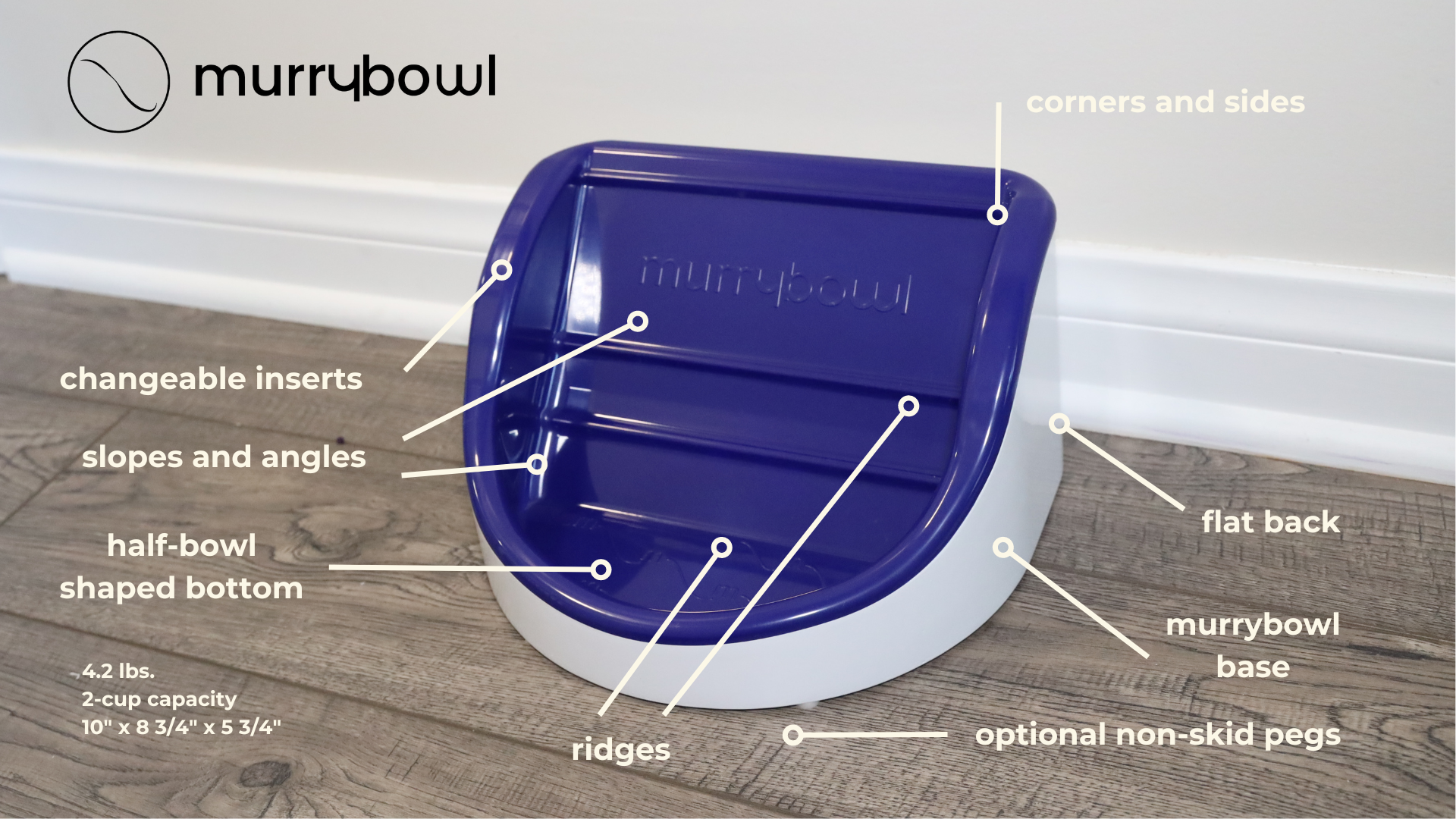
Be selective with slow-feeder patterns
A slow feeder can be interesting for a pet that rushes through meals, but the pattern should fit the pet. Tall pegs, narrow channels, and deep maze walls can turn a simple meal into a frustrating puzzle for a short-muzzled dog. More complicated is not automatically more useful.
If you want to try one, choose low-profile features with open routes to the food. Start with a small familiar portion, then watch whether your pet can locate and gather food without repeated pawing, walking away, or obvious frustration. If the food becomes harder to reach, a simpler surface is likely the better choice.
Measured portions and a predictable schedule can matter just as much as a patterned insert. A bowl’s job is to give food a practical place to sit. It does not need to turn every dinner into a challenge.
Match capacity to the measured meal
Big bowls can look generous, but capacity should follow the portion you serve, not the size of the marketing photo. Measuring the normal meal helps you select a surface that holds food comfortably without spreading it across a vast perimeter. It also helps everyone in the household serve the same amount.
There is evidence that bowl and scoop size can influence how much people portion for their dogs, which is one more reason to use a consistent measuring tool rather than filling by eye. A controlled study of 54 dogs and their owners found that bowl and scoop combinations changed the amount owners served. The study does not prescribe a certain bowl for a breed, but it reinforces a simple habit: measure the meal your veterinarian or food plan recommends.
Murrybowl holds up to two cups and can be used with wet food, dry food, or a combination. That makes the capacity question tangible: start with the normal measured portion, then decide whether the surface keeps that food accessible for your own Paw Pal.
Make cleaning a real buying criterion
Cleaning is not glamorous, but it shapes whether a feeding setup works in real life. Choose a food-contact surface you can lift, wash, and dry without turning every meal into a project. This matters especially with wet food, raw diets, or meals with toppers, which can leave residue in tight seams and complicated grooves.
Regularly cleaning food and water bowls is sensible everyday hygiene. UC Davis veterinary guidance includes cleaning pet food and water bowls as part of routine pet care. If your pet has a special diet or your household includes someone with increased health risks, ask your veterinarian for the right cleaning routine for your situation.
Two removable, dishwasher-safe inserts are part of Murrybowl’s practical appeal. One can be used while the other is washed, so you are not waiting for an entire feeding station to be ready again.
How Murrybowl fits flat-faced pets
Murrybowl was designed for small and medium flat-faced pets, including Frenchies, Pugs, and Bulldogs. Its patented feeding surface combines plate-like slopes, spoon-like angles, fork-like ridges, and texture so food has several places to gather. The open, floor-level approach keeps the focus on accessible food rather than a complicated feeding station.
The design also connects the feeding surface to the ordinary work around it: a weighted base to help it stay put, a flat exterior back that can sit against a wall or cabinet, and two removable inserts for easier cleanup. Pet parents can see the detail behind those choices on Why Murrybowl Works.
Whether it is the right choice still depends on your pet’s normal meal and routine. Explore the Original Murrybowl, see the breed-specific French Bulldog guide or English Bulldog guide, and review shipping and the 30-day satisfaction guarantee when you are ready.
A brachycephalic dog bowl checklist
- Can my pet approach the food without a tall rim or cramped corner getting in the way?
- Does the feeding surface suit the wet food, dry food, or combination I normally serve?
- Will the bowl stay settled on the floor where my pet actually eats?
- Does it fit the measured portion, rather than asking me to guess?
- Can I clean it easily enough to keep the routine going every day?
- Does my pet look comfortable and interested, rather than frustrated?
The best bowl is not the one with the broadest promise. It is the one that gives your pet a practical, approachable place to eat and gives you a feeding routine you can keep.
Frequently asked questions
What does brachycephalic mean in dogs?
Brachycephalic means short-headed. It is commonly used for flat-faced breeds such as French Bulldogs, Pugs, English Bulldogs, Boston Terriers, and Shih Tzus. Individual pets within any breed can have different needs at mealtime.
Do brachycephalic dogs need a raised bowl?
Not automatically. There is no single bowl height that is right for every flat-faced pet, and a bowl should not be treated as a medical solution. Begin with an easy-to-approach feeding surface, then watch your own pet at normal meals. Ask your veterinarian for individual advice if you have health or swallowing concerns.
Are slow feeders suitable for flat-faced dogs?
Some can be, but the pattern matters. Choose a low-profile design with open routes to the food. If your pet repeatedly cannot reach the food or appears frustrated, a simpler feeding surface is likely the better choice.
How do I know whether a bowl is a good fit?
Try it with familiar food, a measured portion, and the usual feeding spot. Look for a comfortable approach, food that remains reachable, a stable base, and a cleanup routine you can realistically keep.
Related posts

Best Dog Bowls for Pugs: A Practical Buying Guide
What Pug pet parents should look for in a bowl, and why an open, stable feeding surface can make everyday meals easier.
Read articleBest Dog Bowls for French Bulldogs: What to Look For
A practical guide to choosing an open, stable, easy-care feeding bowl for a French Bulldog’s everyday meals.
Read article